
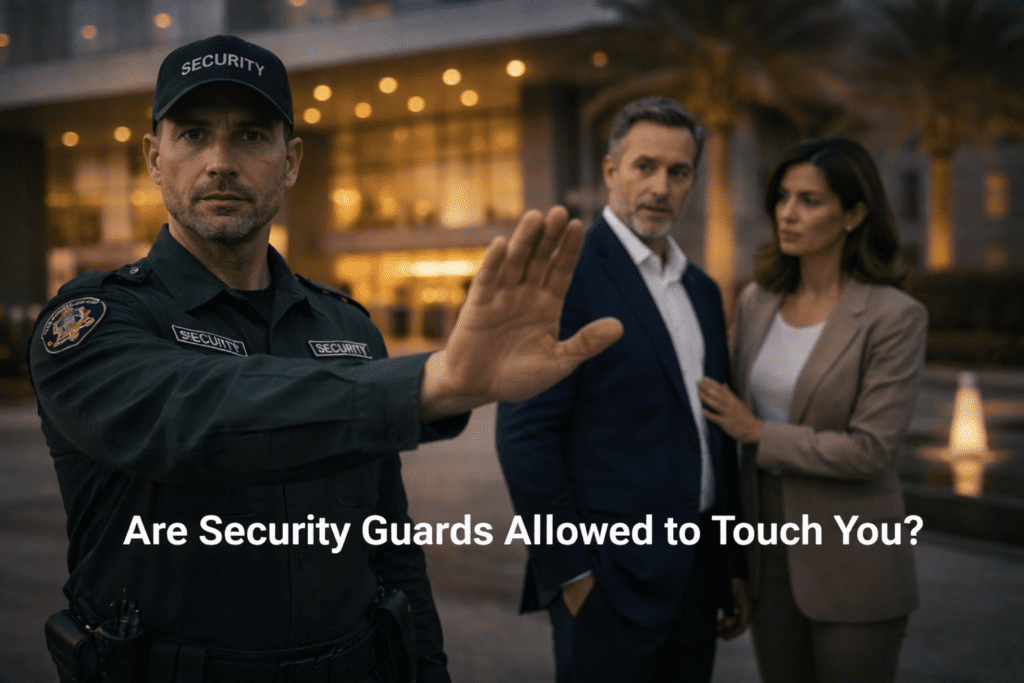
It is a situation many people have experienced or at least wondered about. You are entering a mall, attending an event, or walking through a restricted area, and a security guard stops you. Sometimes, there is physical contact involved. This leads to an important question, are security guards allowed to touch you in Saudi Arabia?
The answer is not a simple yes or no. Security guards do have limited authority to use physical contact in certain situations, but strict rules apply. Their role is to protect, not to enforce the law like police officers.
If you live or run a business in Riyadh, Jeddah, Dammam, Khobar, Dhahran, Mecca, or Medina, understanding these limits is essential. It helps individuals know their rights and helps businesses avoid legal risks.
Are Security Guards Allowed to Touch You in Saudi Arabia, What the Law Really Means
Let’s start with the core idea.
Security guards are allowed to use physical contact, but only in specific and justified situations.
Why This Question Matters in Real Situations
In daily life, physical contact can happen in:
- Shopping malls
- Office buildings
- Airports
- Events and gatherings
Without clear understanding, situations can escalate quickly.
Physical Contact vs Legal Authority
It is important to separate two things:
- Physical contact
- Legal authority
Security guards may touch someone if necessary, but they do not have full law enforcement powers. Their actions must always stay within legal boundaries.
When Security Guards Are Allowed to Touch You
There are certain situations where physical contact is legally acceptable.
Preventing Harm or Danger
If there is an immediate threat, a guard may:
- Move someone out of danger
- Restrain a person causing harm
- Intervene in a fight
The goal is always safety, not punishment.
Stopping a Crime in Progress
If a crime is happening, such as theft, guards may:
- Stop the individual
- Prevent them from leaving
- Use minimal force if required
This is similar to temporary detention until authorities arrive.
Self-Defense Situations
If a guard is attacked or threatened, they can:
- Defend themselves
- Use reasonable force to control the situation
When Security Guards Are NOT Allowed to Touch You
Understanding limits is just as important.
No Unnecessary Force
Guards cannot touch someone without a valid reason. For example:
- No physical contact just to question someone
- No pushing without cause
No Punishment or Intimidation
Security guards are not allowed to:
- Use force as punishment
- Intimidate or harass individuals
- Use physical power to control behavior unnecessarily
No Physical Contact Without Reason
If there is no threat, no crime, and no safety issue, physical contact is not justified.
Use of Reasonable Force Explained
This is the key concept that defines everything.
What “Reasonable” Means in Practice
Reasonable force means:
- Only the minimum force required
- Only for a valid reason
- Only for a short duration
Anything beyond that becomes excessive.
Examples of Acceptable vs Excessive Force
Acceptable:
- Holding someone to stop them from running after theft
- Guiding someone away from a restricted area
Excessive:
- Hitting or causing injury
- Using force when there is no threat
- Continuing force after the situation is under control
Security Guard Laws and Regulations in Saudi Arabia
Saudi Arabia has clear regulations for private security.
Legal Boundaries for Private Security
Security guards must:
- Follow company and government guidelines
- Operate within limited authority
- Avoid acting like law enforcement
Role of Licensed Security Companies
Licensed companies ensure guards are:
- Properly trained
- Aware of legal limits
- Prepared for real-world situations
Real-Life Scenarios in Saudi Arabia
Let’s make this practical.
Shopping Malls in Riyadh and Jeddah
If someone is suspected of shoplifting, a guard may:
- Stop the person
- Use minimal contact to prevent escape
Industrial Sites in Dammam and Khobar
In restricted zones, guards may:
- Physically guide unauthorized individuals out
- Prevent entry if safety rules are violated
Crowded Areas in Mecca and Medina
During peak seasons, guards may:
- Direct crowds physically for safety
- Move individuals to prevent overcrowding risks
Your Rights If a Security Guard Touches You
Even in these situations, you have rights.
Right to Safety and Respect
You should not experience:
- Harm
- Excessive force
- Disrespectful behavior
When You Can File a Complaint
You can take action if:
- Force was unnecessary
- You were treated unfairly
- The guard exceeded their authority
How to Respond in the Moment
If you are in this situation:
- Stay calm
- Avoid resistance
- Ask for clarification
- Cooperate until authorities arrive if needed
What Businesses Must Understand About Physical Contact Rules
For businesses, this topic is critical.
Importance of Training
Proper training ensures guards:
- Understand legal limits
- Handle situations professionally
- Avoid unnecessary escalation
Legal Risks of Untrained Guards
Untrained guards can:
- Use excessive force
- Damage business reputation
- Create legal issues
If you want to understand hiring better, you can refer to your guide on how to hire security guards.
You can also explore types of security guards to choose the right role for your business.
If you are looking for reliable protection, our professional security guard services provide trained personnel who understand Saudi regulations and handle situations responsibly.
FAQs
Are security guards allowed to touch you in Saudi Arabia?
Yes, but only in specific situations such as preventing harm or stopping a crime.
Can a security guard push or restrain someone?
Only if it is necessary and reasonable to control a situation.
Is it legal for guards to use force?
Yes, but only minimal and justified force.
What should I do if a guard uses too much force?
You can report the incident to authorities.
Can security guards search you physically?
Only under certain conditions and within legal limits.
Conclusion
So, are security guards allowed to touch you in Saudi Arabia? Yes, but only within strict legal boundaries and only when necessary.
Their role is to protect people and property, not to act as police. Physical contact must always be reasonable, justified, and limited.
For individuals, knowing your rights helps you stay informed and safe. For businesses in Riyadh, Jeddah, Dammam, Khobar, Dhahran, Mecca, and Medina, proper training and hiring the right security team is essential.
Security is not just about control, it is about responsibility, professionalism, and trust.
 English
  Arabic