
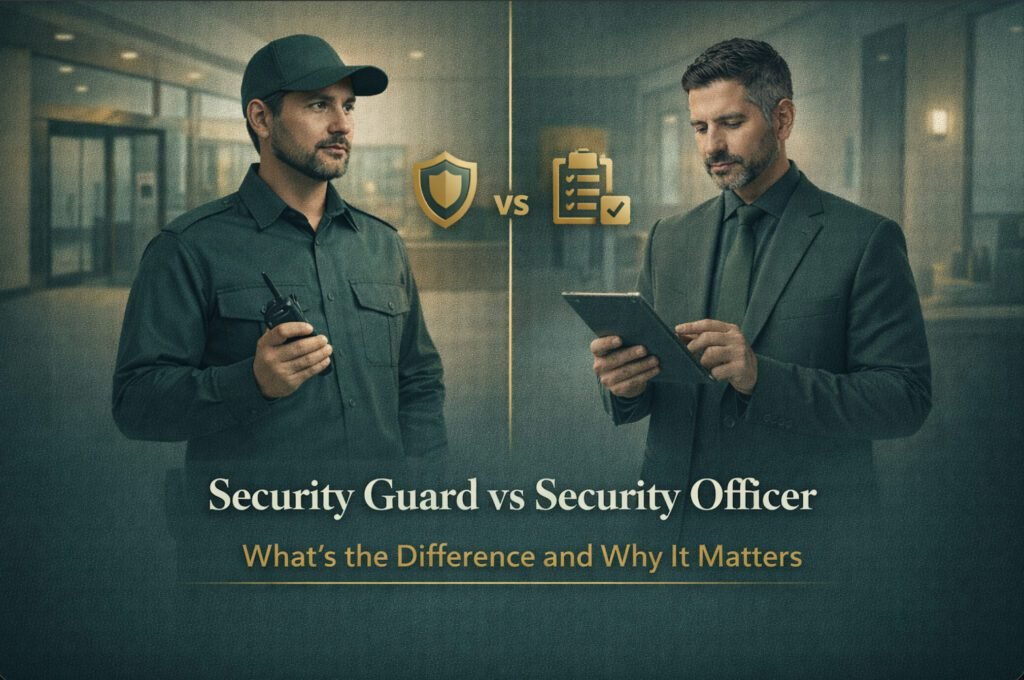
The terms security guard and security officer are often used interchangeably, which can create confusion for businesses, property managers, and even job seekers. In Saudi Arabia, this confusion is common across commercial buildings, residential communities, and corporate environments. While the two roles are closely related, they are not always the same.
Understanding the difference between a security guard and a security officer helps organizations set clearer expectations, choose the right level of security, and communicate roles more effectively.
What is the difference between a security guard and a security officer?
The difference between a security guard and a security officer is less about legal authority and more about responsibility, scope, and professional focus. In most cases, both roles operate under the same legal limits, but their day-to-day functions and expectations can vary.
In simple terms, a security guard role is usually task-focused, while a security officer role is often responsibility-focused.
What does a security guard typically do?
A security guard is usually assigned to carry out specific, clearly defined duties at a particular location. Their role focuses on presence, observation, and basic access control.
Typical responsibilities of a security guard include:
- Monitoring entrances and exits
- Conducting routine patrols
- Observing and reporting suspicious activity
- Enforcing site rules and access procedures
- Responding to basic incidents
Security guards are commonly found at gates, checkpoints, reception areas, construction sites, and residential entrances. In Saudi Arabia, they form the backbone of everyday security operations across many industries.
What does a security officer typically do?
A security officer usually has a broader scope of responsibility and may be assigned to environments that require higher levels of professionalism, coordination, or decision-making.
A security officer’s role may involve:
- Supervising other security staff
- Coordinating security operations across a site
- Managing incident response and reporting
- Liaising with management or authorities
- Ensuring compliance with security procedures
Security officers are often deployed in corporate offices, business towers, high-profile facilities, or sites with more complex security needs.
Differences in responsibility and accountability
One of the main differences between the two roles lies in accountability. Security guards are typically responsible for performing assigned tasks, while security officers are often responsible for overseeing how security is delivered.
For example:
- A security guard may monitor a single entrance
- A security officer may oversee multiple access points and staff
This difference does not mean one role is more important than the other. Instead, it reflects how security operations are structured.
Training and experience expectations
While both roles require training, security officers are often expected to have additional experience or leadership skills. They may receive extra training in reporting, coordination, and incident management.
In Saudi Arabia, professional security providers often assign the title security officer to personnel who demonstrate higher levels of responsibility, communication skills, and situational awareness.
Authority and legal limits
A common misconception is that security officers have more legal authority than security guards. In reality, both roles operate under the same legal framework.
Neither security guards nor security officers:
- Act as law enforcement
- Have arrest powers beyond limited temporary detention
- Can exceed defined legal boundaries
The title does not change legal authority. It reflects responsibility and function rather than power.
Appearance and professional presence
In many corporate and concierge environments, the title security officer is used to reflect a more professional or service-oriented image. These roles often emphasize communication, discretion, and interaction with employees, executives, and visitors.
Security guards, on the other hand, may be positioned in more operational roles where visibility and routine control are the priority.
Both roles require professionalism, but the emphasis can differ depending on the environment.
Which role is right for your site?
Choosing between a security guard and a security officer depends on the complexity of the site and the level of oversight required.
A security guard may be sufficient when:
- Duties are clearly defined
- The environment is routine and predictable
- Minimal supervision is needed
A security officer may be more appropriate when:
- Multiple guards are deployed
- The site requires coordination and reporting
- Management interaction is frequent
Many locations use a combination of both roles to maintain balance and efficiency.
Why understanding the difference matters
Clarity in roles improves communication, performance, and accountability. When organizations understand what each role entails, they are better equipped to structure security teams effectively and avoid misunderstandings.
Clear role definitions also help guards and officers perform confidently within their responsibilities.
Working with professional security providers
Experienced providers such as Qimah Security Services understand how to assign the right personnel based on site needs rather than titles alone. The focus is on matching skills, experience, and responsibility levels to the environment being protected.
This approach ensures that security operations remain effective, compliant, and well-coordinated.
FAQs
Is a security officer higher than a security guard?
Not legally. A security officer often has more responsibility or oversight, but both roles operate under the same legal authority.
Can a security guard become a security officer?
Yes. With experience, training, and demonstrated leadership, guards are often promoted into officer roles.
Do security officers carry weapons?
Not necessarily. Most security roles in Saudi Arabia are unarmed, regardless of title.
Which role is more suitable for corporate environments?
Security officers are commonly used in corporate settings due to their communication and coordination responsibilities.
Final thoughts
So, what is the difference between a security guard and a security officer? The distinction lies in responsibility, scope, and professional focus rather than authority. Security guards handle defined tasks and presence-based duties, while security officers often oversee operations, coordination, and reporting.
In Saudi Arabia’s diverse security landscape, both roles are essential. When assigned correctly, they work together to create structured, professional, and effective security that supports people, property, and daily operations.