
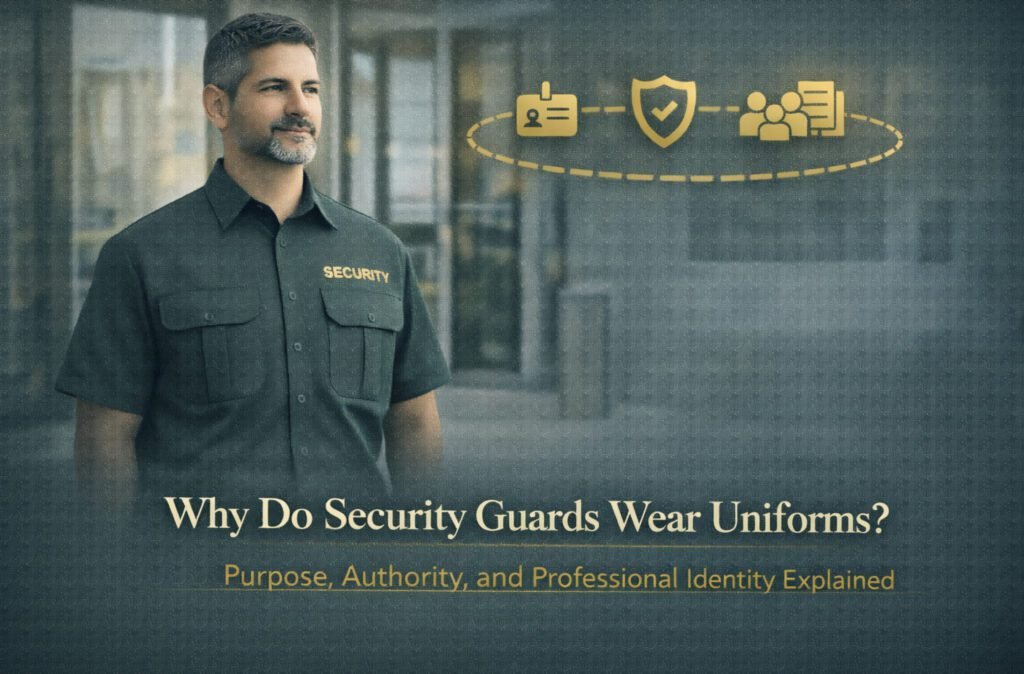
Security guard uniforms are instantly recognizable. Whether at an office building in Riyadh, a residential compound, a shopping mall, or a large event, the uniform is often the first thing people notice. But uniforms are not just about appearance. They play a practical, psychological, and operational role in how security works.
Understanding why security guards wear uniforms helps explain how visibility, authority, and professionalism come together to create safer environments across Saudi Arabia.
Why do security guards wear uniforms?
Security guards wear uniforms to clearly identify their role, establish authority, and support preventive security. A uniform signals that security is active, organized, and present, which alone can reduce the likelihood of incidents.
In many cases, the uniform does as much work as the guard themselves by discouraging unwanted behavior before it starts.
Clear identification and recognition
One of the most important reasons for uniforms is easy identification. People should be able to quickly recognize who is responsible for security.
Uniforms help:
- Visitors know who to approach for help
- Employees and residents identify authorized security staff
- Prevent confusion with unauthorized individuals
In busy environments, clear identification saves time and reduces uncertainty.
Authority without confrontation
Uniforms establish authority in a calm and non-aggressive way. A clearly marked security uniform communicates rules and control without the need for verbal enforcement.
This helps:
- Encourage compliance with site rules
- Reduce arguments or resistance
- Maintain order without escalation
In Saudi Arabia’s professional and community-focused environments, this balance between authority and respect is especially important.
Deterrence through visibility
A visible uniform acts as a deterrent. People are less likely to attempt theft, vandalism, or unauthorized access when they know security is present and alert.
Uniformed guards:
- Signal that an area is monitored
- Reduce opportunities for misconduct
- Help prevent incidents rather than react to them
Preventive security is always more effective than reactive security.
Professional image and trust
Uniforms contribute to a professional image that builds trust. A clean, well-maintained uniform shows that security is taken seriously and properly managed.
This professionalism:
- Reassures employees, residents, and guests
- Reflects positively on the organization or property
- Encourages cooperation rather than tension
In corporate and residential settings, appearance strongly influences how security is perceived.
Consistency and accountability
Uniforms create consistency across security teams. When guards are dressed the same way, it reinforces structure and accountability.
Consistency helps:
- Identify assigned personnel easily
- Distinguish guards from visitors or staff
- Reinforce discipline and standards
Badges and identification worn with the uniform further support accountability.
Supporting communication and interaction
Uniforms make interactions smoother. When people know they are speaking to an official security guard, instructions are more likely to be followed without question.
This is especially useful when:
- Giving directions
- Managing entry points
- Addressing rule violations
Clear role recognition reduces misunderstandings.
Cultural and situational appropriateness
In Saudi Arabia, uniforms are designed to be modest, professional, and suitable for the environment. Different settings may require different styles.
For example:
- Corporate environments may use formal uniforms
- Events may require discreet but identifiable attire
- Industrial sites use more practical, durable clothing
The goal is always the same: visibility without discomfort or intimidation.
Uniforms are not about intimidation
A common misconception is that uniforms are meant to intimidate. In professional security, the opposite is true. Uniforms are meant to reassure, organize, and prevent problems quietly.
Well-trained guards rely on awareness and communication, not fear.
When uniforms may not be used
In certain specialized roles, such as discreet observation or close protection, guards may wear plain clothes. However, these are exceptions rather than the norm.
For most security roles, visibility through uniforms remains essential.
FAQs
Do all security guards have to wear uniforms?
Most do, especially in manned guarding, residential, commercial, and event security. Uniforms are part of standard professional practice.
Are security guard uniforms similar to police uniforms?
No. Professional security uniforms are designed to be clearly different from law enforcement to avoid confusion.
Can uniforms affect how people behave?
Yes. Visible uniforms often encourage compliance and reduce misconduct without confrontation.
Why are badges worn with uniforms?
Badges and ID confirm legitimacy, authority, and accountability.
Final thoughts
So, why do security guards wear uniforms? Because uniforms support identification, authority, deterrence, and professionalism all at once. They help security guards do their job more effectively without relying on force or confrontation.
In Saudi Arabia’s diverse commercial, residential, and event environments, uniforms play a key role in creating order and confidence. When combined with proper training and discipline, a security guard’s uniform becomes a powerful tool for prevention, trust, and everyday safety.
 English
  Arabic