
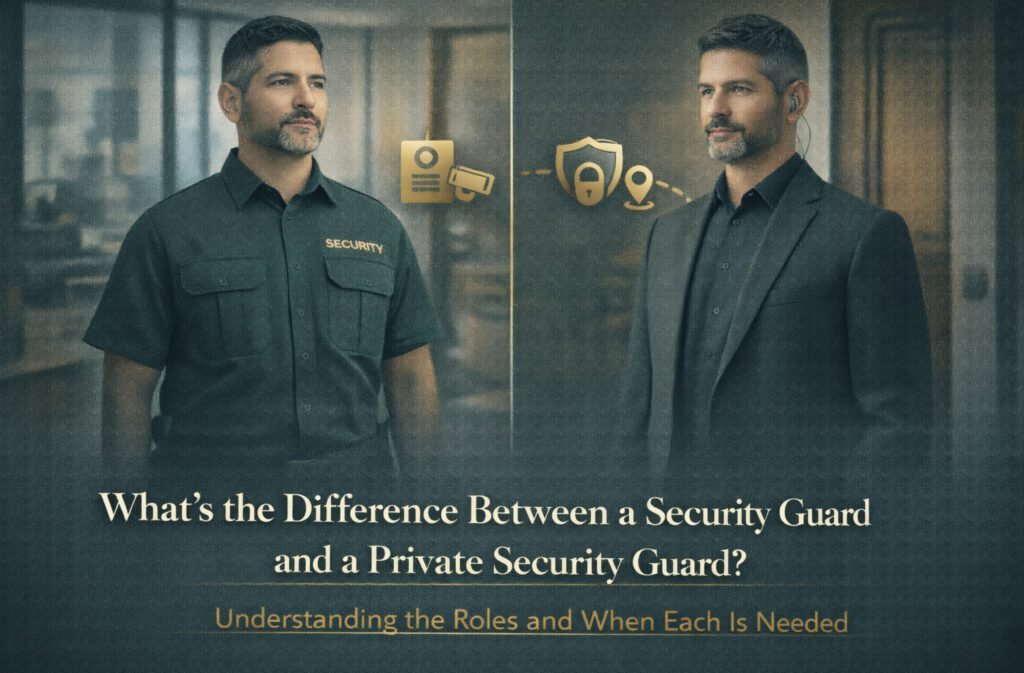
The terms security guard and private security guard are often used as if they mean the same thing. In everyday conversation, they usually do. However, when it comes to roles, authority, and how security services operate in Saudi Arabia, there are important distinctions worth understanding.
Knowing the difference helps businesses, event organizers, and individuals choose the right type of security and set clear expectations from the start.
What’s the difference between security guard and private security guard?
The difference between a security guard and a private security guard is not about uniforms or legal power, but about who they work for and under what authority. In practice, the term security guard is broad, while private security guard is more specific.
In Saudi Arabia, most guards you see are private security guards, even if they are commonly referred to simply as security guards.
What is a security guard?
A security guard is a general term used to describe a person whose job is to protect people, property, or premises. This term does not, by itself, explain who employs the guard or what legal framework they operate under.
The title security guard can be used informally to describe:
- Guards at commercial buildings
- Guards at residential compounds
- Guards at events or construction sites
Because the term is broad, it can sometimes create confusion about authority and responsibility.
What is a private security guard?
A private security guard is a security guard who is employed by a licensed private security company or contracted directly by a private organization through such a company. Their authority comes from the property owner or client they serve, not from the government.
In Saudi Arabia, private security guards:
- Operate under private security regulations
- Are assigned to protect specific sites or individuals
- Focus on prevention, access control, and reporting
This distinction is important because private security guards are not part of law enforcement or public safety agencies.
Differences in authority and legal powers
One of the most common misconceptions is that a private security guard has more authority than a regular security guard. In reality, their legal authority is the same.
Neither security guards nor private security guards:
- Have police powers
- Can conduct criminal investigations
- Can arrest people beyond limited temporary detention
- Can use force beyond what is reasonable to prevent immediate harm
The difference lies in structure and accountability, not power.
Differences in employment and accountability
The main practical difference between the two roles is employment.
A private security guard:
- Is employed by a licensed security company
- Is trained, supervised, and managed professionally
- Operates under clear contracts and procedures
When people use the term security guard without “private,” they may simply be using shorthand. In Saudi Arabia, almost all non-government guards fall under private security services.
Differences in scope of duties
While duties often overlap, private security guards usually work within clearly defined scopes set by contracts and site requirements.
Their duties commonly include:
- Access control and visitor management
- Monitoring and patrolling premises
- Enforcing site rules
- Reporting incidents and safety issues
Because private guards work under contractual agreements, their responsibilities are often more structured and documented.
Public perception and terminology
The term security guard is widely used because it is simple and familiar. The term private security guard is more precise and is often used in legal, contractual, or professional contexts.
In corporate, residential, and event environments, both terms may refer to the same person. The difference is mostly about clarity rather than function.
Why understanding the difference matters
Understanding this distinction helps:
- Set realistic expectations about authority
- Avoid confusion with law enforcement roles
- Ensure compliance with Saudi regulations
- Choose licensed and accountable security services
Clarity reduces risk and improves cooperation between guards, clients, and the public.
Choosing professional private security services
When hiring security in Saudi Arabia, the focus should always be on professionalism, licensing, and suitability rather than job titles. Experienced providers such as Qimah Security Services emphasize training, compliance, and clear role definitions to ensure guards perform effectively within their legal boundaries.
This approach ensures security supports safety without overstepping authority.
FAQs
Is a private security guard different from a police officer?
Yes. Private security guards work in the private sector and do not have law enforcement powers.
Are all security guards private security guards in Saudi Arabia?
Most non-government security personnel are private security guards employed by licensed companies.
Does the title affect what a guard can legally do?
No. Legal authority depends on regulations and role limits, not job titles.
Which term should businesses use?
Both are commonly used, but private security guard is more precise in contracts and legal contexts.
Final thoughts
So, what’s the difference between a security guard and a private security guard? In practice, it comes down to clarity rather than capability. A security guard is a general term, while a private security guard clearly describes a guard working under a licensed private security framework.
In Saudi Arabia’s commercial, residential, and event environments, understanding this difference helps ensure security is professional, compliant, and effective. When roles are clearly defined and properly managed, security becomes a reliable support system rather than a source of confusion.
 English
  Arabic