
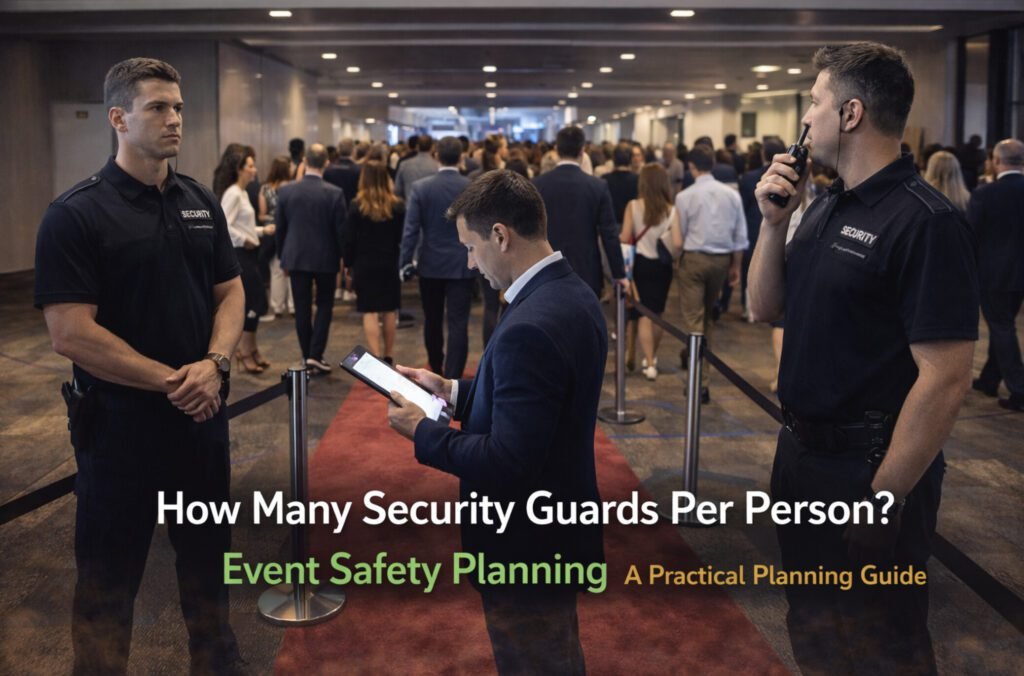
Planning an event involves many moving parts, but security is one area where guesswork can create real problems. One of the most common questions organizers ask is how many security guards per person an event actually needs. The answer is not a fixed number, because effective event security depends on context, risk, and how people move through the space.
In Saudi Arabia, where events range from private gatherings to large corporate functions and public celebrations, getting the security ratio right is essential for safety, comfort, and smooth operations.
How many security guards per person event planners should consider
There is no universal rule that applies to every event. Instead of focusing on a single ratio, professional security planning looks at crowd behavior, venue layout, and risk level.
As a general reference point:
- Small, low-risk private events often require minimal security presence
- Medium-sized corporate or social events need structured coverage
- Large or high-profile events require layered and visible security
The goal is not to flood the venue with guards, but to position the right number in the right places.
Why there is no fixed security-to-guest ratio
Many people search for a simple formula, such as one guard per a certain number of guests. In reality, this approach can be misleading.
Several factors influence security needs more than headcount alone, including:
- Number of entrances and exits
- Venue size and layout
- Guest profile and behavior
- Event duration
- Presence of VIPs
- Time of day and location
For example, 200 guests in a single indoor hall require a very different setup than 200 guests spread across an outdoor venue with multiple access points.
Typical security coverage ranges for events
While exact numbers vary, experienced event planners and security providers often use ranges as a starting point before adjusting based on risk.
Common reference ranges include:
- Small private events: one to two guards mainly for access control and presence
- Medium events: guards positioned at entrances, key internal areas, and crowd flow points
- Large events: multiple guards covering access points, internal zones, and perimeter areas
These ranges are always adjusted after assessing the venue and event type.
How venue layout affects guard numbers
Venue design plays a major role in determining how many guards are needed.
Key layout considerations include:
- Multiple entrances or gates
- Separate parking or arrival areas
- Outdoor spaces with open boundaries
- Stages, VIP sections, or restricted zones
Each additional access point usually requires at least one dedicated guard, regardless of guest count.
Guest profile and event type matter
The type of event influences security requirements just as much as size.
For example:
- Corporate events usually require discreet, professional security focused on access and coordination
- Weddings and private celebrations focus on guest management and privacy
- Public or promotional events require stronger crowd control and monitoring
Events with high-profile guests or media presence often need additional security regardless of total attendance.
Static guards vs mobile coverage at events
Event security usually combines static and mobile roles rather than relying on one approach.
Static guards are typically placed at:
- Entrances and exits
- VIP or restricted areas
Mobile guards:
- Move through the crowd
- Monitor behavior
- Respond quickly to issues
Using both allows fewer guards to cover more ground effectively.
Avoiding under- or over-securing an event
Too few guards can lead to delayed response, crowding issues, or loss of control. Too many guards can make guests uncomfortable and affect the atmosphere.
Balanced event security aims to:
- Be visible but not intrusive
- Prevent issues rather than react to them
- Support the flow of the event
This balance is especially important in Saudi Arabia, where hospitality and respect are key expectations at social and corporate gatherings.
Working with professional event security planners
Rather than relying on rough estimates, many organizers work with experienced security providers to assess their events properly. A professional assessment looks at people flow, timing, and risk rather than just numbers.
Providers such as Qimah Security Services are often chosen for events because they understand how to scale security appropriately while maintaining a welcoming environment suited to Saudi cultural and social norms.
FAQs
Is there a minimum number of security guards required for an event?
There is no universal minimum. Requirements depend on venue rules, event size, and risk level.
Do private events really need security guards?
Not always, but security is recommended when guest numbers increase, privacy matters, or the venue is open and accessible.
Can one security guard handle a large number of guests?
Only in very low-risk, controlled environments. Larger or more complex events require multiple guards.
Should security be present for the entire event?
Yes, especially during guest arrival, peak activity, and departure times.
Final thoughts
So, how many security guards per person event planning requires cannot be reduced to a simple formula. Effective event security depends on understanding people, space, and risk rather than counting heads alone.
In Saudi Arabia’s diverse event landscape, the best approach is thoughtful planning that places the right number of guards where they are most needed. When security is planned properly, it supports safety quietly in the background, allowing guests to enjoy the event while organizers remain confident that everything is under control.
 English
  Arabic