
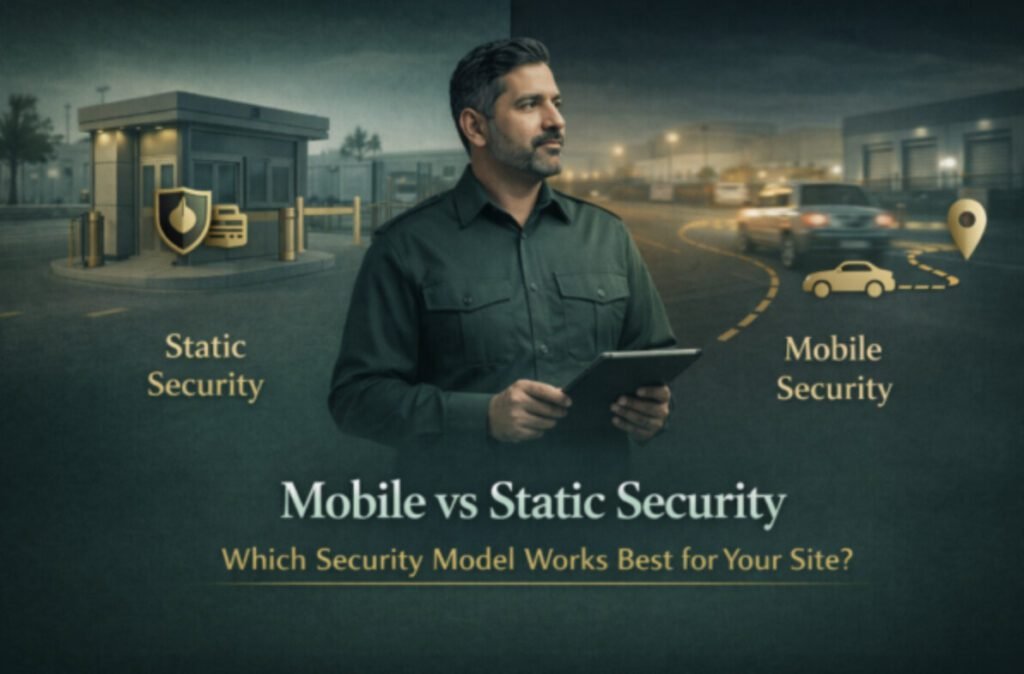
When planning security for a property, one of the most important decisions is choosing between mobile security and static security. Both approaches are widely used across Saudi Arabia, from industrial zones and construction sites to residential compounds and commercial facilities. However, they serve different purposes and suit different environments.
Understanding the difference between mobile vs static security helps ensure that protection is effective, practical, and aligned with real operational needs rather than assumptions.
Mobile vs static security: what’s the difference?
The difference between mobile and static security lies in how guards are deployed and how they cover a site.
Static security involves guards stationed at fixed locations such as entrances, gates, reception areas, or checkpoints. Mobile security relies on guards who patrol larger areas, either on foot or using vehicles, following planned or variable routes.
Both models focus on prevention and visibility, but they achieve it in different ways.
What static security is best suited for
Static security works best where access control and continuous presence at a specific point are required. These guards become familiar with daily routines, authorized personnel, and site procedures, which strengthens control and consistency.
Static guards are commonly used in:
- Office buildings and corporate headquarters
- Residential compounds and gated communities
- Commercial facilities and shopping centers
- Hospitals and public buildings
In Saudi Arabia, static security is often the first layer of protection because it allows clear control over who enters and exits a property. A guard stationed at an entrance can quickly identify unauthorized access, enforce rules, and respond to issues as they arise.
Advantages of static security
Static security offers several practical benefits:
- Constant visibility at critical access points
- Strong control over entry and exit
- Familiarity with people and routines
- Immediate response at fixed locations
This model is especially effective in environments with high foot traffic or where a controlled first impression is important.
What mobile security is designed for
Mobile security is designed for larger or more spread-out locations where a single fixed post is not enough. Mobile guards patrol multiple areas during a shift, reducing blind spots and making security less predictable.
Mobile patrols are commonly used for:
- Industrial zones and warehouses
- Construction sites
- Large residential compounds
- Facilities with multiple buildings or open spaces
In many Saudi facilities, especially those operating after hours, mobile security provides wider coverage without requiring a guard at every location.
Advantages of mobile security
Mobile security offers flexibility and efficiency, particularly for large sites.
Key advantages include:
- Wider coverage with fewer guards
- Reduced predictability for potential intruders
- Ability to monitor multiple risk areas
- Quick response across larger properties
Patrol vehicles are especially effective in industrial and construction environments, where distances between buildings can be significant.
How environment influences the choice
Choosing between mobile vs static security depends largely on the environment and risk profile.
For example:
- A corporate office benefits from static guards at entrances to manage visitors and access.
- A warehouse complex may rely on mobile patrols to cover large outdoor areas.
- A residential community may use static guards at gates combined with mobile patrols inside the compound.
In practice, many sites use a combination of both models to create layered security rather than relying on a single approach.
Cost and operational considerations
Cost is often a deciding factor, but it should be considered carefully. Static security may require more personnel if multiple access points exist, while mobile security can cover wider areas with fewer guards.
However, mobile security is not always a replacement for static posts. Locations with high visitor interaction still need fixed guards to manage access and communication effectively.
Operational needs, working hours, and site layout all influence which model offers better value rather than simply looking at guard numbers.
Mobile vs static security in Saudi Arabia
Saudi Arabia’s security landscape includes large commercial developments, industrial zones, and residential communities spread across wide areas. Because of this, mobile security is particularly useful for sites with open layouts, while static security remains essential for controlled environments.
Climate also plays a role. Patrol vehicles help guards operate efficiently in hot conditions, while static posts often require shaded or indoor positions to maintain comfort and alertness during long shifts.
Understanding local conditions helps ensure guards remain effective throughout their deployment.
Choosing the right security approach
The best security solution is rarely about choosing one model over the other. Instead, it is about matching the right approach to the site’s actual needs.
A proper assessment considers:
- Size and layout of the property
- Number of access points
- Level of activity and foot traffic
- Operating hours and risk periods
Experienced providers such as Qimah Security Services typically recommend blended solutions, combining static guards at key points with mobile patrols for wider coverage.
FAQs
Is mobile security better than static security?
Not always. Mobile security is better for large areas, while static security is essential for access control and high-traffic locations.
Can one site use both mobile and static security?
Yes. Many facilities combine both approaches to create layered and more effective security coverage.
Does mobile security respond faster to incidents?
Mobile patrols can reach incidents across large sites more quickly, but static guards provide immediate response at fixed locations.
Which option is more cost-effective?
It depends on site layout and risk level. Mobile security can reduce the number of guards needed, but static posts are often non-negotiable for controlled access.
Final thoughts
The choice between mobile vs static security is not about which model is better overall, but which one fits the environment and risks involved. Static security provides strong control and presence at critical points, while mobile security delivers flexibility and broader coverage.
In Saudi Arabia’s diverse commercial and residential landscape, the most effective security strategies often combine both approaches. When security is planned around real conditions rather than assumptions, it becomes a reliable system that protects people, property, and operations without unnecessary complexity.
 English
  Arabic